
Most drivers never think about what’s happening inside their transmission—and honestly, you shouldn’t have to.
Your vehicle is supposed to start, drive smooth, and get you where you need to go without a second thought.
But when something goes wrong inside a transmission, it can go from “barely noticeable” to “completely undriveable” faster than you’d expect.
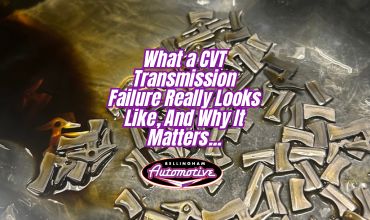
And sometimes… it looks like this.
What You’re Looking At
Those small metal pieces are actually part of a CVT belt.
Unlike a traditional transmission that uses gears, a Continuously Variable Transmission (CVT) uses a belt and pulley system to adjust seamlessly as you drive. That’s what gives you that smooth, almost unnoticeable acceleration.
That “belt” isn’t rubber like you might imagine—it’s made up of hundreds of precisely engineered steel segments working together as one continuous unit.
When everything is working properly, you never notice it.
When it fails… all those pieces come apart.
How Does a CVT Belt Fail?
CVT failures don’t usually happen out of nowhere. There’s almost always a buildup to it.
Some of the most common causes include:
- Lack of proper maintenance or fluid changes
- Overheating
- Internal wear over time
- Manufacturing weaknesses (depending on the vehicle)
Once the belt starts to weaken or slip, it creates additional stress on the system—and that’s when things can escalate quickly.
Signs Something Isn’t Right
The tricky part is that early warning signs can be easy to ignore.
If you notice any of the following, it’s worth getting checked sooner rather than later:
- Hesitation when accelerating
- Jerking or shuddering while driving
- Unusual whining or grinding noises
- RPMs increasing without a matching increase in speed
- A general feeling that something is “off”
These symptoms might seem minor at first—but they’re often the only warning you’ll get before a bigger failure.
Why Catching It Early Matters
Here’s the reality:
Catching a CVT issue early can sometimes mean a repair, fluid service, or minor component replacement.
Waiting too long?
That’s when you’re looking at a full transmission replacement.
And as you can imagine… that’s not a small expense.
The Bottom Line
Your transmission is one of the most complex and important systems in your vehicle—and it’s not something you want to ignore when it starts acting differently.
If your car doesn’t feel right, there’s a reason.
Getting it checked early can save you time, stress, and a lot of money down the road.
If you have questions or want a second opinion, we’re always here to help.